

What is Hostitle Narrative Analysis?
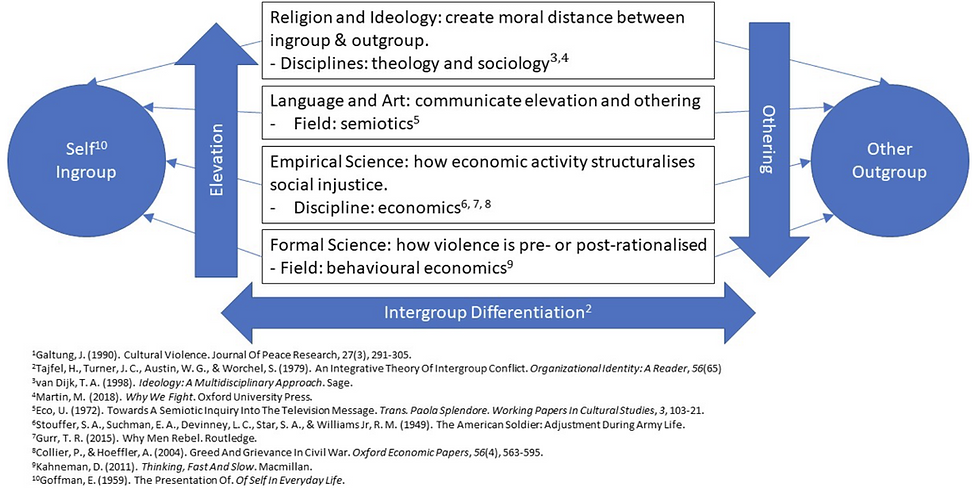
Hostile narrative analysis seeks to detect and explain how texts legitimise violence through the narratives people tell themselves. It is a human-centric approach that uses natural language processing (NLP) combined with a rigorous theoretical foundation in Peace Studies. It uses Johan Galtung’s theory of cultural violence by measuring a “Self–Other gradient”: the discursive process by which a speaker elevates the ingroup (“Self”) while debasing or devaluing an outgroup (“Other”). The steeper this gradient, the more the text legitimises hostility or violence toward the Other. This Self-other gradient provides an explanatory, theory-led alternative to standard hate-speech or sentiment classifiers, which often lack grounding in social theory and can distort an orator’s/writer’s intended meaning when reduced to coarse labels or aggregate sentiment scores.
In our increasingly polarised world, understanding the development and dissemination of adversarial messages is essential but it’s about more than detecting hate speech or negative sentiment in texts. Hate speech is a polysemous term; its meaning differs across platforms, cultures and legal systems; using it to classify texts can obscure an orator’s intended meaning. Sentiment analysis often fails to distinguish between abusive or non-abusive rhetoric across extreme texts (e.g. it fails to detect the harmful legitimisation cloaked in neutral or positive tones in phrases like “protecting our people”). Both methods also use NLP, treating human language as a series of data points, with words detected in isolation from their grammatical patterning, which is a major difference between the processing of language by an algorithm rather than by a human.
Hostile narrative analysis responds to the shortcomings of hate speech detection by analysing clauses and patterned linguistic constructions that build the Self–Other gradient. Through its focus on narrative roles and legitimation strategies, hostile narrative analysis can flag hostile narratives that avoid overt slurs or negativity. Ultimately, hostile narrative analysis yields richer outputs, with a transparent methodology that also generates clearly interpretable results. It combines qualitative with quantitative analysis to create human-centric AI that works with and for the human who needs to make decisions based on its results.
Simple outline of method
Collect texts; resolve entities and pronouns for group references.
Identify Self/Other mentions (combines search for patterns, named entity recognition, or NER and coreference recognition in which two or more expressions refer to the same real-world entity).
Tag clauses for elevation of Self and debasement/othering of Other using curated lexicons and dependency patterns.
Compute a gradient metric at document/section level.
Visualize highlights and clause-level evidence; compare across documents to spot steeper gradients.
Validate data by cross referencing against texts with known orientations to violence (e.g., Mein Kampf, War on Terror texts) vs. non-violent rhetoric (e.g. Martin Luther King ‘I have a dream’ speech), to test whether the gradient reflects real-world differences.
Conclusion
Hostile Narrative Analysis “outperforms” not necessarily on generic hate-speech benchmarks, but by providing more valid, theory-led, and interpretable detection of how texts legitimise hostility—an analytic advantage when the goal is understanding and intervening in harmful discourse.
Comments